A governed operating system for AI-collaborative work.

Launchpad OS is my working system for turning AI-assisted work into structured delivery. Projects start with a scaffold, move through focused sessions, and leave behind an auditable trail of decisions, commits, and outcomes.

This site is proof of the method: concept to live URL in
under eight billable hours.

Not a tool. Not a template. An operating system.

Launchpad OS is not another AI tool or prompt template. It is a governed methodology for running AI-assisted project work: fast to start, coherent across sessions, and auditable from the first decision to the final commit.

The core problem it solves: AI-assisted work has no natural structure. Sessions accumulate. Context drifts. Decisions get made twice, or lost entirely. The work feels fast in the moment and becomes expensive to recover when it is not governed. Launchpad OS gives that work a spine.

Every project follows the same operating rhythm. A structured spin-up produces the project spec and scaffold. Each session has one goal, explicit close criteria, and a required closeout: a pushed commit or a documented blocker. Three continuity documents preserve decisions, session records, and topic history across sessions and across the AI model boundary.

The system has been refined across sixteen revisions. It is not experimental.

  • Fast to start: project scaffold, first commit, and live working environment in the first session
  • Coherent across sessions: decisions, records, and topic history preserved across the AI model boundary
  • Auditable at every stage: every session closes with a pushed commit or documented blocker, logged with actual timestamps

Three domains. One operating system.

Proof 01

Rimrock

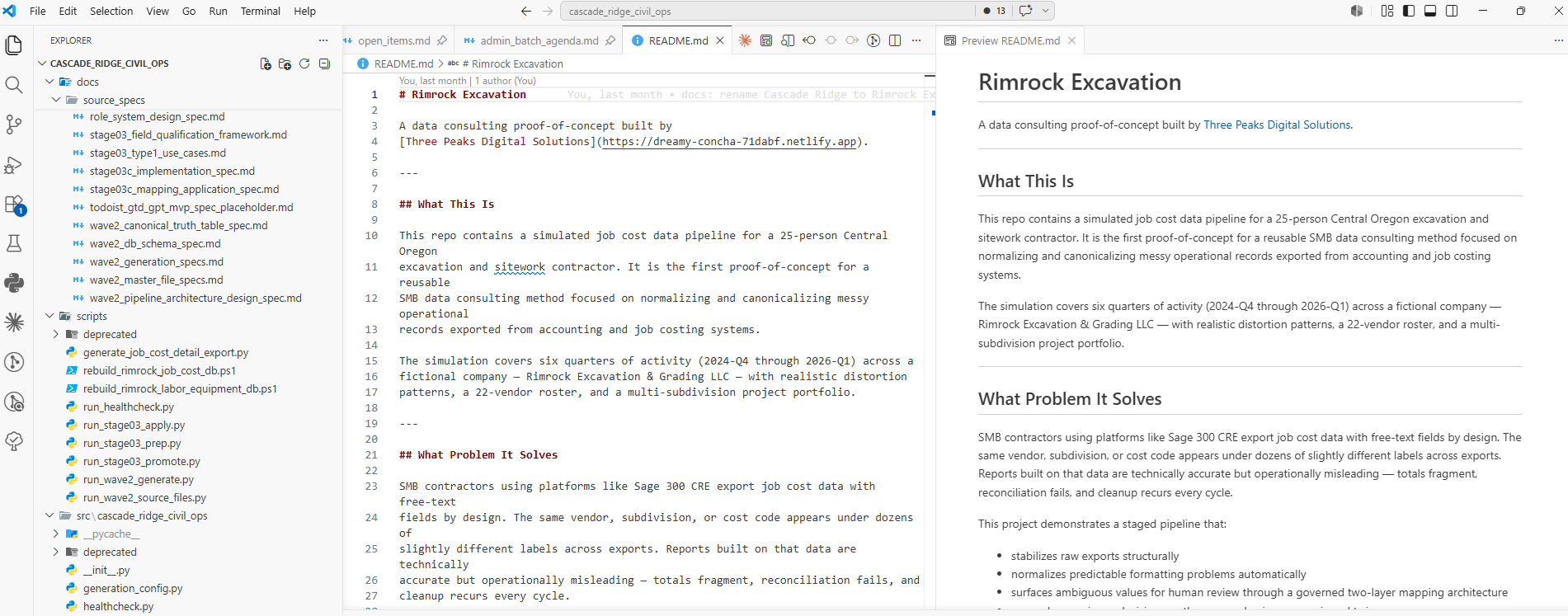
Rimrock is a sitework contracting scenario built to demonstrate Launchpad OS in a data operations context. The contractor is fictional. The data is simulated. The problem it illustrates is not.

The problem: field data arrives messy, inconsistent, and difficult to trust. The goal was to build a pipeline that turns that input into a reviewable exception surface: every anomaly visible, every transformation traceable, and every output understandable to someone who was not in the room when it was built.

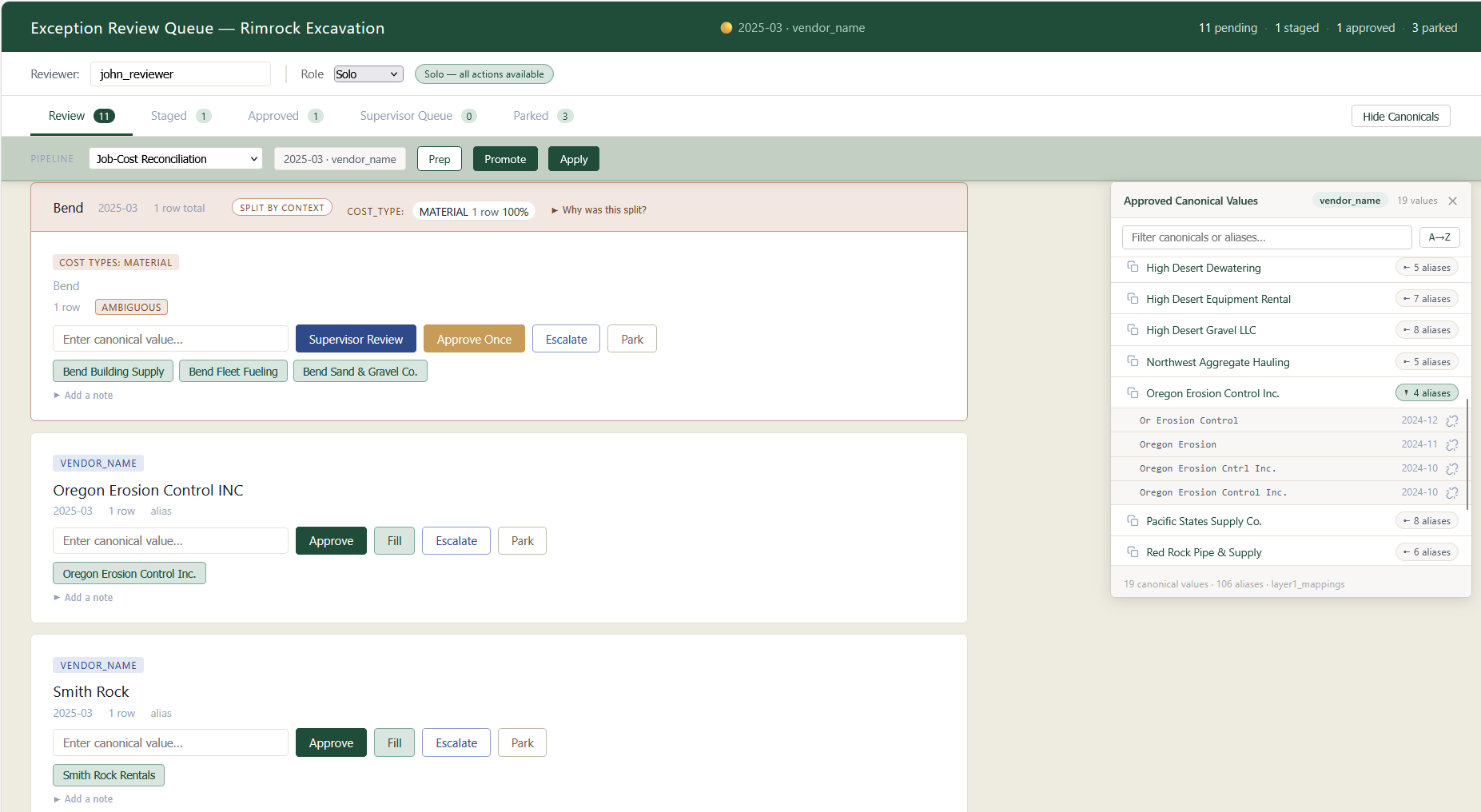
Launchpad OS governed the build from first scaffold to review queue. Each session had a defined goal, a closeout record, and a commit trail. The result is a working exception surface: anomalies categorized, prioritized, and linked back to the transformations that produced them.
Explore the Rimrock demo →

Data operations Exception surface Audit trail
Rimrock Excavation repository in VS Code showing project structure, scripts, and README Rimrock exception review queue showing the pipeline exception surface with categorized anomalies, alias suggestions, and canonical values panel
Proof 02

Other Nations

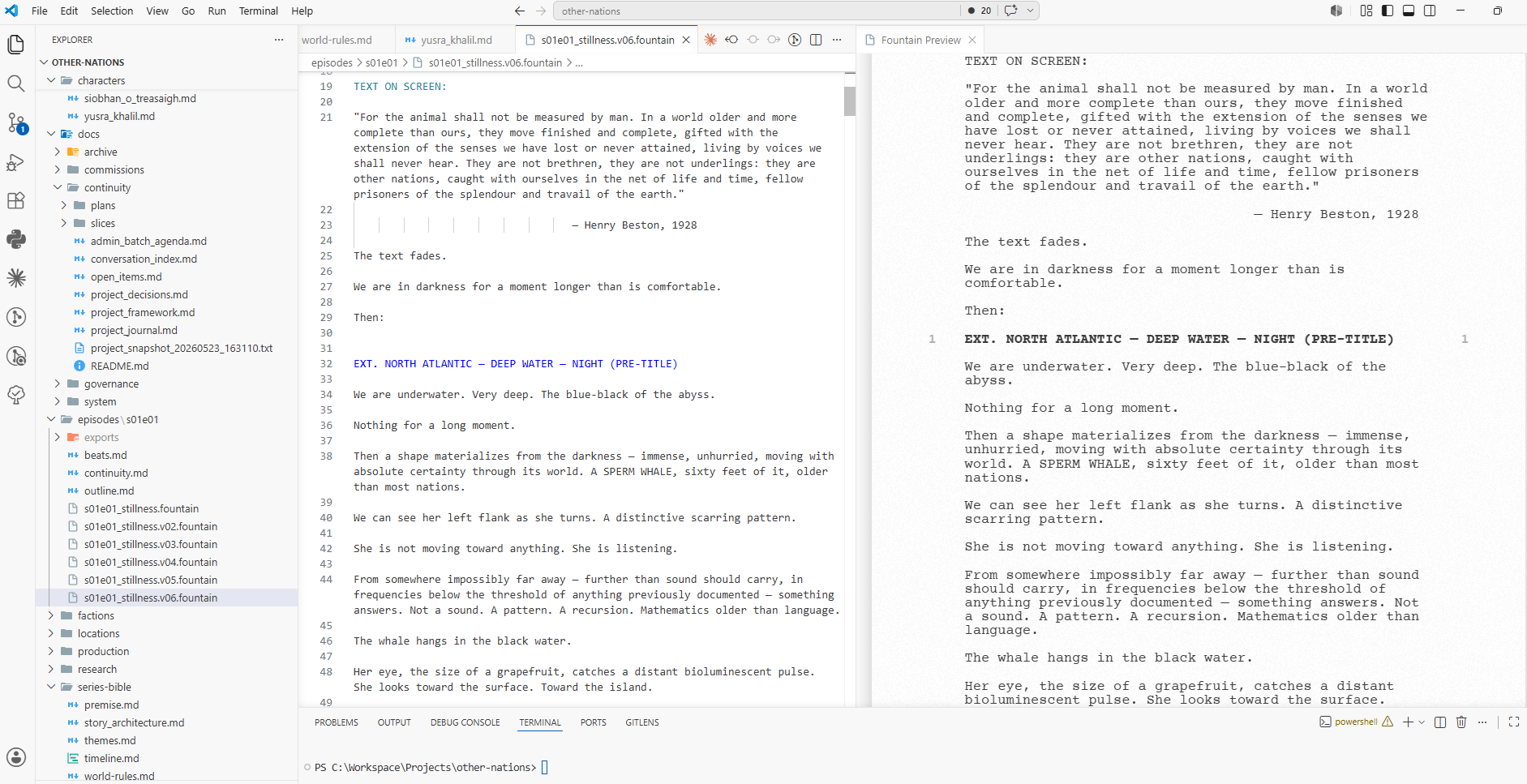
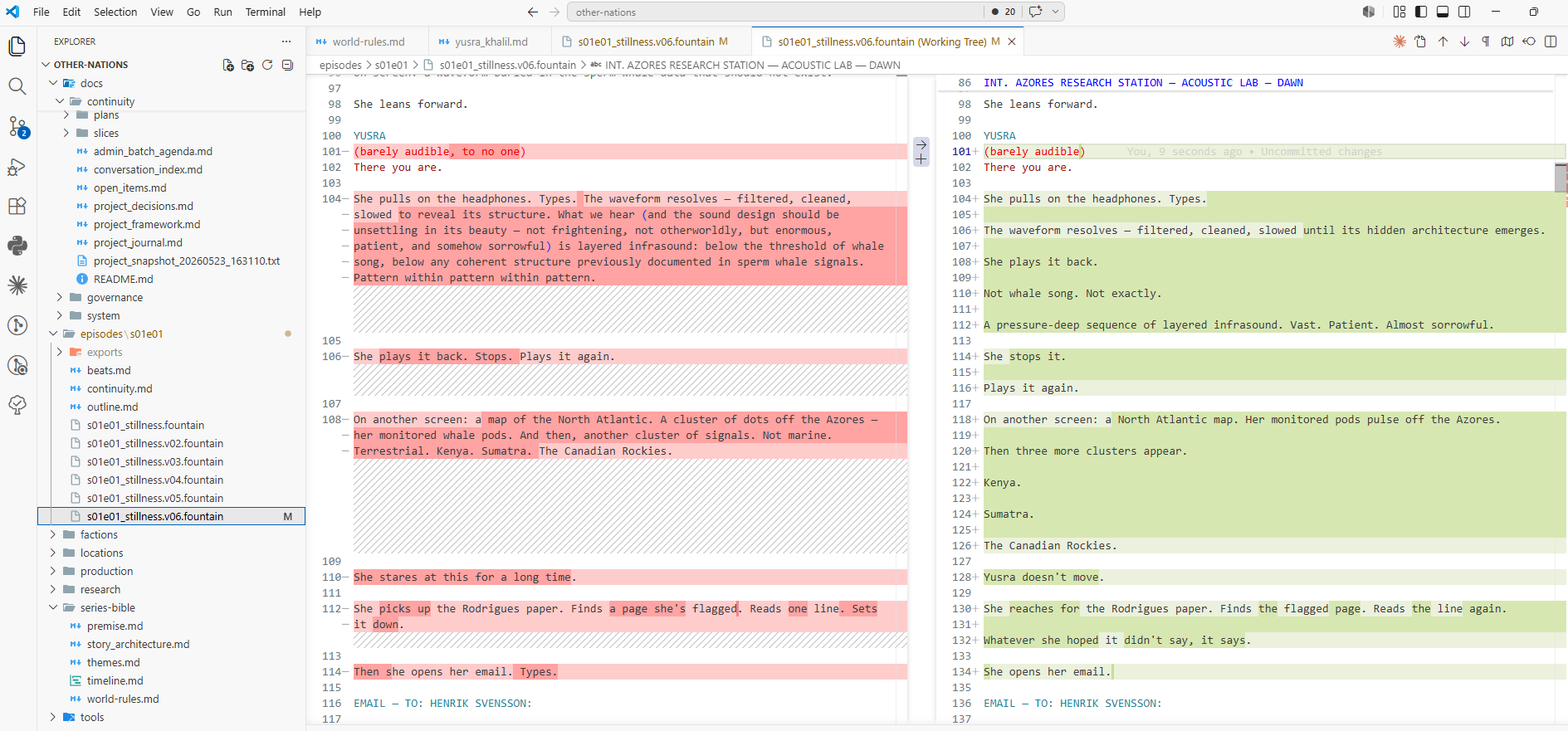
Other Nations is a television drama universe managed like a software repository. Series bible, episode scripts, character documents, location profiles, faction logic, and production materials all live in structured source files. Markdown and Fountain are the working formats. Git handles versioning. The point was not to turn writing into software. The point was to prove that Launchpad OS can govern complex creative continuity with the same spin-up and session model used for operational builds.

Continuity across a complex world. World rules, character history, faction logic, and timeline constraints stayed findable across sessions.

Voice consistency across AI-assisted drafts. Style decisions were captured in the decisions log instead of being rediscovered each time.

Fast, governed spin-up. The artifact type changed, but the operating model did not.

The entire environment runs on free, open-source tooling. No Final Draft license required.

The underlying creative content is not exposed here. The proof is the structure: repository layout, document types, versioning model, and the same three-document continuity backbone adapted for creative decisions instead of engineering decisions.

Creative production Screenwriting Voice consistency
Other Nations episode script in VS Code: raw Fountain source alongside formatted screenplay preview Other Nations script diff view in VS Code showing tracked revisions between screenplay versions
Proof 03

This Site

You just read about two domains. This is the third.

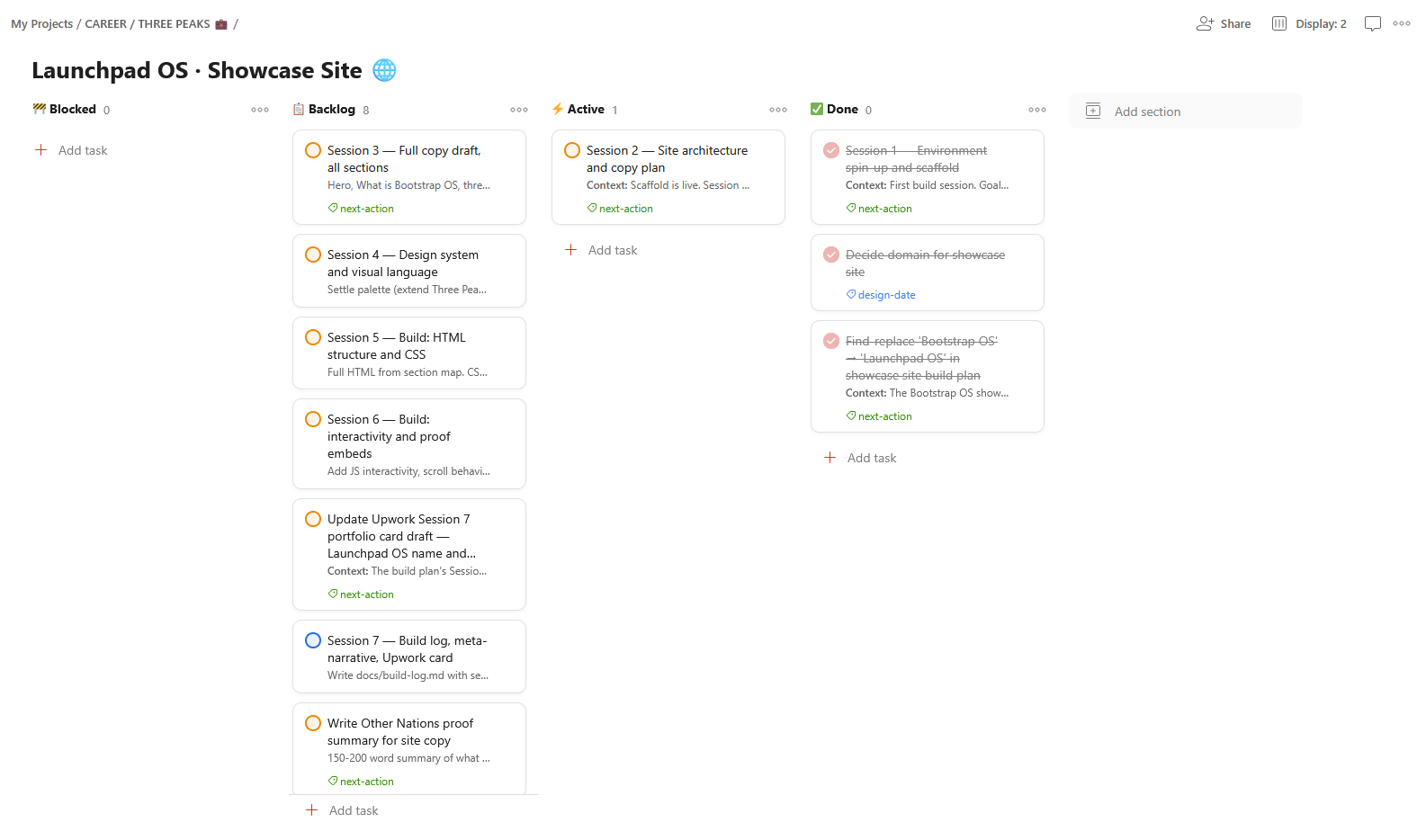
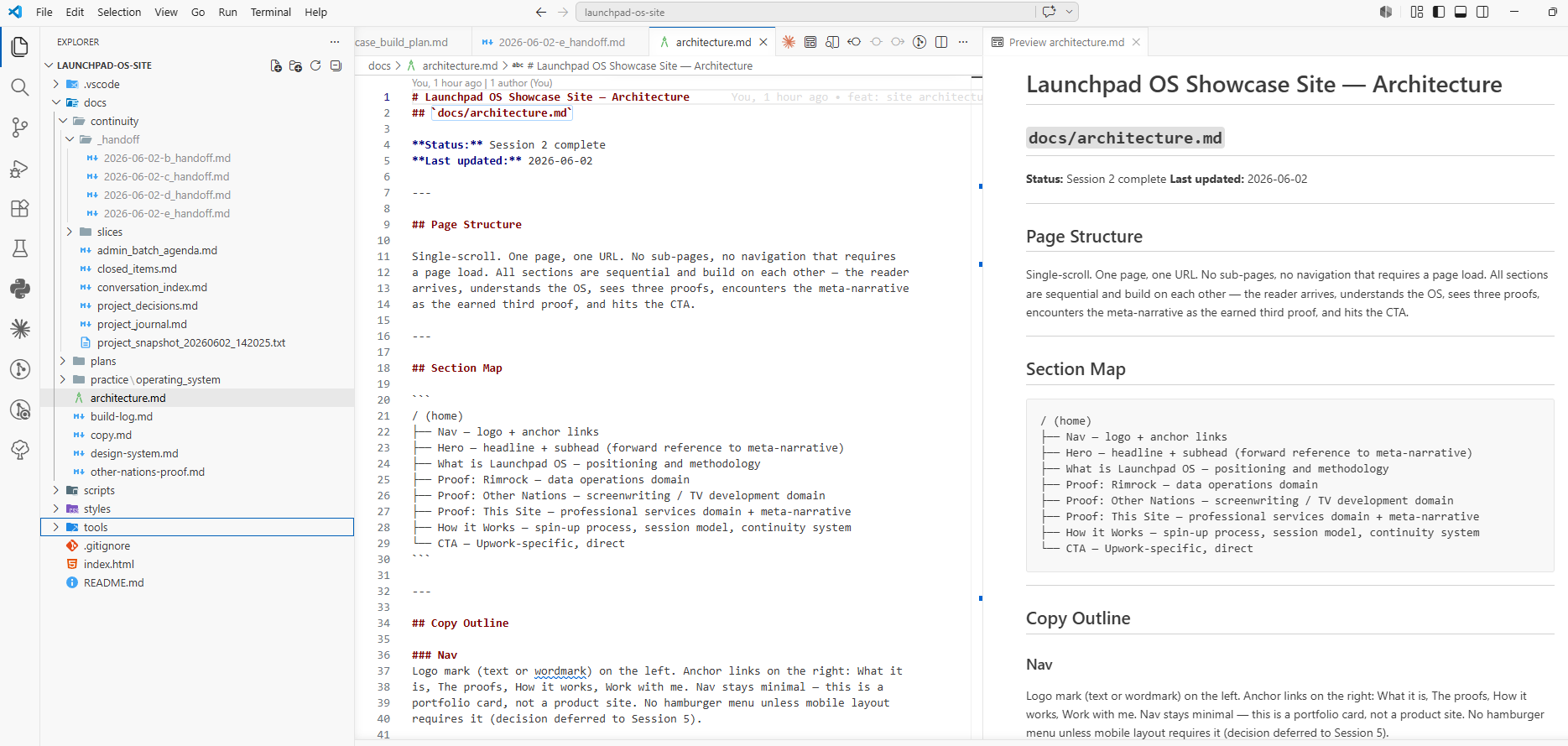
This site was built using the same OS it documents. Session 1 produced the project spec, scaffold, first commit, and live URL. Everything after that (architecture, copy, design system, HTML, CSS, and build log) moved through the same session model and continuity system described above.

Environment to live URL: under 24 hours. Documented session by session, with actual timestamps, in the build log linked below.

This is not a footnote. It is the third proof. Rimrock shows data operations. Other Nations shows creative continuity. This site shows professional services delivery: the method used to create the thing you are reading.

Build log →

Professional services Under 24 hours Meta-proof

Wall time: 12h 17m · Active work: 6h 21m

Launchpad OS Todoist board: four-lane Kanban view of the session-based build workflow Launchpad OS site repository in VS Code: architecture.md open with file tree visible

Three elements carry every project.

The spin-up

Every project opens with a structured interview. The interview produces a confirmed project spec: name, scope, folder structure, working mode, constraints, and governance requirements. From that spec, a bootstrap script generates the full scaffold.

  • Directory structure, continuity files, and VS Code configuration
  • Initial commit, GitHub remote, and working delivery surface
  • Environment to first commit in a single session

The session model

Every session has one goal, stated at open. Close criteria are explicit and agreed before work begins. A session closes when the checklist is fully checked, a commit is pushed, and elapsed time is logged with actual timestamps.

  • No unbounded exploration, no silent scope drift
  • If work moves outside the session goal, it is named immediately
  • If work stalls, the blocker is documented instead of buried

The continuity system

Three documents carry every project across sessions and across the AI model boundary. A new session can open cold, load the current position, and work without reconstruction.

  • Project journal: what was accomplished each session and why
  • Topic index: where to find prior work, decisions, and context
  • Decisions log: permanent record of architectural, scope, and delivery decisions

Bring this operating model to your project.

View my Upwork profile →

Launchpad OS is available for new client engagements. I use it to help turn ambiguous ideas, messy workflows, and AI-assisted builds into structured projects with visible progress, documented decisions, and a clear delivery trail. If that is the kind of help you need, my Upwork profile is the next step.